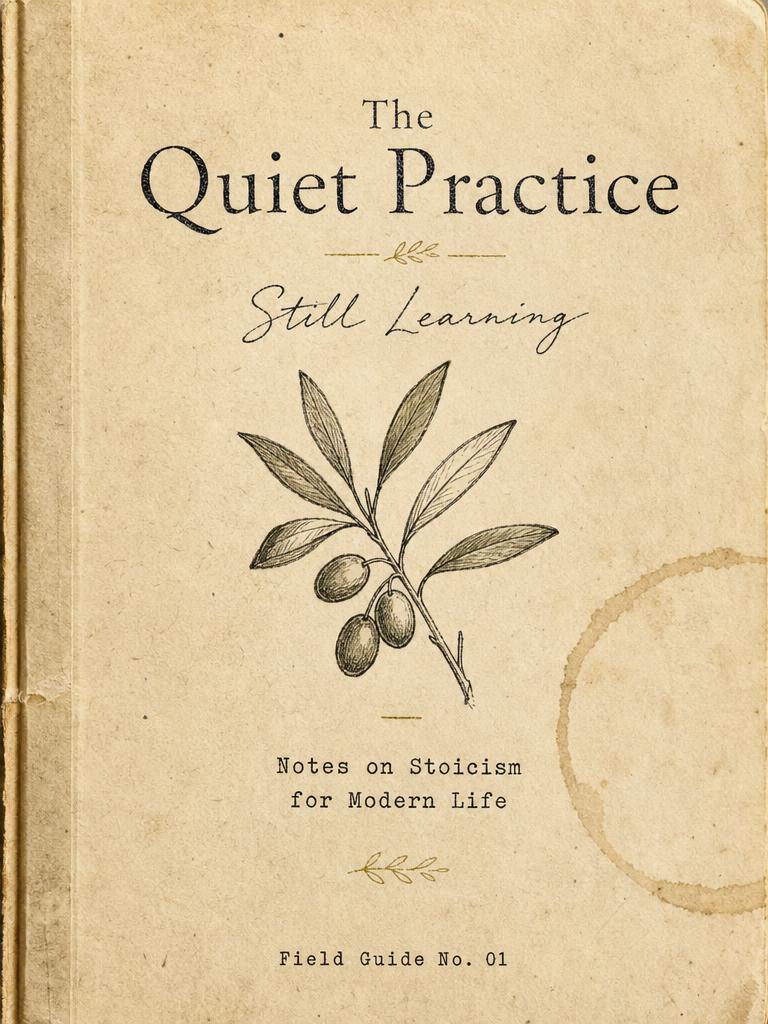
A personal field guide · Publishing Fall 2026
The Quiet Practice
Still Learning
Notes on Stoicism for work, family, mind, and sport
A short, honest journal written from the middle of a busy life — not because the author has it figured out, but because the practice of returning, again and again, is what keeps him steady.
Releasing Fall 2026 · Join the waitlist to be first in line
What this is
Not a manifesto, not a course, and not another motivational book. Just a small, honest collection of notes from someone still figuring it out — on how the old Stoic ideas land in a modern week of meetings, kids, training sessions, sleepless hours, and everything between.
- Around 80 pages — short enough to finish in an evening, dense enough to return to.
- Personal notes and lived examples, not abstract philosophy.
- Stories from the author's own life — including seasons shaped by addiction, mental health struggles, and quiet recovery — and the Stoic ideas that helped find footing again.
- Reflections on how Stoic wisdom meets different life stages: early ambition, burnout, parenthood, loss, and starting over.
- Practical prompts at the end of every chapter, written like notes to a friend.
- Delivered as a PDF and ePub — read anywhere, keep forever.
Chapters
- IWork
The desk and the noise
On difficult decisions, honest conversations, and staying useful when the days are long. What Stoicism actually changes about how you show up on a Monday morning.
- IIFamily
Being present with the people we love
Patience as a practice, not a personality trait. Small notes on parenting, marriage, and returning home already tired.
- IIIMind
The weather of the mind
Anxious mornings, restless nights, and the practices I lean on when the inner weather turns. Stoicism as quiet mental hygiene, not a cure.
- IVSport
The body as training ground
Why running, lifting, and long walks became part of my practice. Discomfort on purpose, and what it teaches the rest of the day.
- VDaily
Morning and evening
The two small rituals that hold the whole thing together. Prompts, questions, and the notebook I actually use — imperfect, coffee-stained, and real.
From the book
“I did not come to Stoicism because I had life figured out. I came to it because I did not. Some evenings I still don't. But the practice — the small, daily returning — is what has kept me steady enough to keep showing up.”
— from the introduction
A note from the author
I write anonymously because this practice does not belong to me — I am only borrowing from a two-thousand-year-old conversation. These notes are the ones I wish someone had handed me a decade ago, when work felt heavy, sleep felt short, and I did not yet know that the mind is something you can, quietly and patiently, train.
The Quiet Practice · Publishing Fall 2026
Join the waitlist
The Quiet Practice is being written now and will be released in Fall 2026. Leave your email and I'll let you know the moment it's ready — waitlist readers get first access and an early-reader price.
Questions
- When is the book coming out?
- The Quiet Practice is planned for release in Fall 2026. Everyone on the waitlist will be notified first and offered an early-reader price.
- Is this only for people in high-pressure jobs?
- No. It is written for anyone — parents, students, athletes, professionals — who wants a calmer, more deliberate way of moving through an ordinary week.
- Do I need to know anything about Stoicism first?
- Not a thing. The book introduces the ideas gently as they become useful. If you are already familiar, the practical chapters will still be new.
- How personal does it get?
- Personal. The book includes stories from my own life — including seasons shaped by addiction, mental health struggles, and slow recovery — and how Stoic ideas met me in each of those life stages.
- How long is it, and what formats?
- Around 80 pages, delivered as PDF and ePub. Short by design — meant to be read once in an evening, then kept close and returned to.
While you wait
The books, apps and courses that shaped this one are gathered in the shop — with an honest note on each.
Visit the Stoic Shop